Pademelon
Published:
Updated:
January 10, 2026
December 10, 2025
Way back when, somewhere in the dark recesses of the early 2000’s, there was a chap by the name of Tim Hopey who had a small company called… Hopey. While there had been numerous efforts before, Tim nailed the concept of steering dampers for mountain bikes, with a very low profile device that slotted into the steerer tube via the stem. Having come from a moto design background, I’d always thought the idea was valid so whacked one into my then bike. The difference it made to the overall handling of the bike was astounding and I kind of became a convert. But that was then, when head angles were steep, wheels were ‘small’ and trails were hand cut. And the bike, and the Hopey, were stolen.
Fast forward to now. I had several Hopeys in the parts drawer I’d picked up from Zukerbook and had been entertaining the idea of using them again for a while; I’d gone so far as contacting Tim about a service but by the time I decided to do anything about it, he’d closed the business due to ill health (as I understand it). Usually that would be that but in this case it was far from it. As it turned out, one Jeremiah Boobar had taken over the mantle, setting up his company ‘Pademelon‘ in Maydena Tasmania, of all places. A quick search for Jeremiah Boobar and you’ll soon find he’s a chap with an impressive list of credentials in the mountain bike industry, so one would be wise to assume that if he’s taken to reviving Tim Hopey’s steering damper, he is going to do it seriously.
And he has.
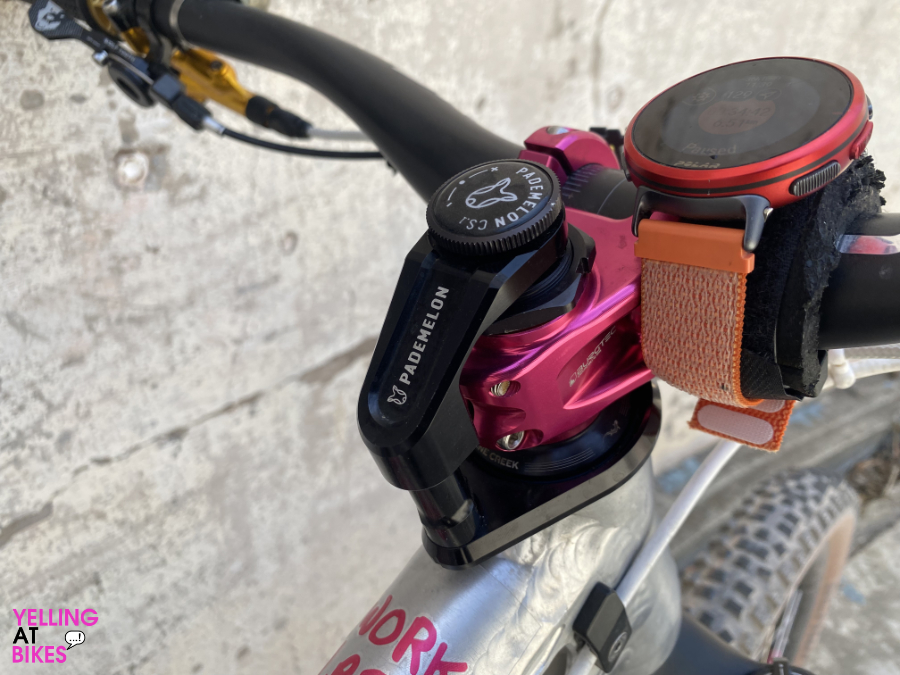
What follows is a review on the dampener I have, not a brand new Pademelon CS-1 unit, as they are now called. Pademelon offers servicing on all Hopey units, bringing them in line with their latest offerings, but while I sent down a Hopey and got back a Pademelon with new seals, adjuster, arm and head tube mount, I am not sure if internally (valving etc.) the Hopey is the same as the new Pademelon, considering they have done a lot of testing and refining over the original design. Regardless, I dropped it into the bike and off I went.

The interesting part about this review is that I installed the damper on a new Nicolai, a bike miles different from the bike I had been riding. I’d been riding the Nicolai for some months prior to installation, so had a good chunk of time to not only get used to the bike but also get a real feeling for it’s handling which was, as my review goes into, outstanding. Adding the Pademelon was going to be an interesting exercise in seeing just how much a difference a damper would make to a modern bike, especially when used for every day trail riding and not being gnar!
To begin, for those that are unfamiliar, just what is a steering damper?
Probably the easiest way to describe the way it works is to think of the oil bath in your fork. At its (absolute) most basic, a valved piston moves through the oil bath and dampens the motion of the spring as the oil passes through port/valve in the piston body, slowing what’s called the rebound. How much the damper slows the rebound of the fork is dependant on how open or closed the valve is – closing the valve all the way more or less slows the motion to the point that the fork locks out while opening it up, which creates less resistance, increases the speed of the rebound as there is less resistance to the force of the spring. The steering damper works in a similar fashion, dampening the motion of the bars against sudden jolts and movement as the, let’s just call it, piston moves through its motion. Unlike a fork though, the setup is somewhat more sophisticated as this diagram explains…

The CS.1 offers position-sensitive damping, delivering constant support across a 75-degree range where maximum damping assistance is most effective. Between 37.5 and 90 degrees this effect is intentionally absent, ensuring manoeuvrability in tight corners without resistance. As the bars return to centre, damping or resistance is removed to enable precise control and ensures your front wheel remains on its desired course.
Like a fork dampener, the amount of dampening can be tuned via a dial at the top of the unit and while you can’t lock it out, for very obvious reasons, you can make it very firm. For many riders, this concept of slowing the steering down not only seems counter intuitive but downright daft. I am here to tell you though it’s neither of those things.
Out of the box, the feeling admittedly was a little odd. Even though I knew exactly what to expect, the first time riding again with a dampener installed took a little getting used to but as you can tune in the dampening, I set it at a very low resistance in order to get reacquainted. Over time I have progressively wound up the resistance, so that now the Pademelon is more or less permanently on and I have a small range of adjustment I float within depending what I am riding. To the uninitiated, that makes it sound like I’d be wrestling the bars all the time but I can assure you, the only time I actually notice the resistance is when I am walking the bike or putting it on the racks; riding with the increased resistance has faded away entirely.
‘That’s nice Dear, but how does it ride?’
Well here’s the kicker – riding with the Pademelon has made an excellent bike even better. It’s a hard thing to quantify but the best way to describe it is that the damper has simply made the front end ‘quiet’. By that I mean you don’t realise how much chatter you subconsciously tune out when you ride. On (proper) trails with rocks, dips, loose surfaces etc. etc. your brain filters out all the micro movements and the little adjustments you do through the bars to accomodate this trail ‘noise’. Your brain does this in much the same way it filters out counter steering, where at speed you actually initiate a turn by pushing the bars, however slightly, in the opposite direction to the turn. And it’s these subconscious micro movements you make over the course of a ride that accumulate to help fatigue you physically and mentally. The damper negates the noise by giving the front end a planted stance, allowing it to track as solidly as the rear, all the small jitter that comes up through the bars is effectively filtered out. This does not mean it deadens the feeling, far from it, it simply removes the background noise that you are constantly correcting; as strange as it seems, one of the places you really notice this is on singletrack climbs, where the front wheel starts tracking where you want rather than being easily deflected.
Somewhere I read that with a Pademelon installed, the front end of the bike matches the feeling of the back, with both having the same solid tracking feeling. That’s probably a nice way of putting it and on fast bermed sweepers you really notice that the bike feels like it’s carving through the turns like a snowboard (where you turn on a single edge) which of course invites you to push harder than you otherwise would.
I’ll be honest and say I can’t comment on how the Pademelon performs through the likes of fast rock gardens, they are not really my thing. But the trails I ride have plenty of rocks, log drops, loose sand and the like and in every instance the feeling through the bars is far more assuring with than it was without and without fail I find myself going faster through these features than I had prior to the Pademelon’s installation. But perhaps, and this is not something I’ve read in any review to date, the single biggest selling feature of the Pademelon is that it is, unequivocally, an arse saver. On more than one occasion since having installed it, it has save me from dropping the bike when the front wheel clipped or slipped on a rock at speed – the sort of thing where the bars torque out of your hands and you and up having an ugly high-side (as I did early ’24). In every case, the damper slowed the snap of the bars enough that I could easily keep control and stay upright, including one instance in the wet where my hand slipped and rolled on the gip, twisting the bars and pitching me forward in a very brown stain moment.
While most of the reviews you will read about the Pademelon revolve around enduro and DH style riding, I can say without a skerrick of doubt that for overall trail riding, where you can ride a full range of features and terrain over the course of a ride, outside of tyres, it is one of the single biggest improvements you can make to your bike. You’ll have to decide if the cost is worth it to you but on the scale of things, considering it’s more of a long term investment that’s not only transferrable between bikes but also unlikely to either wear out or be superseded with the latest and greatest, I think it’s a pretty solid investment, especially as Pademelon offers a full rebuild service.
Visit: Pademelon
Gerard
I've sold titanium, designed and sold cycling rags, was co-conspirator for Australia's first major MTB website, run mtb events, designed bikes, and was a GM and head designer for a famous but sadly now extinct mtb bike marquee; and after 20 odd years I decided riding bikes was more fun than working with them.
Today I pedal (boom-tish!) cycling t-shirts

